Find out who can't buy from your shop — and stay sure it stays fixed
Your site changes every month — a theme update or a new app can quietly undo any fix. We assess your shop against WCAG 2.1 AA, then watch it month after month and keep a dated record that proves it's being managed. Free on one page. The assessment is €149 — credited in full if you subscribe to monitoring.
Find out on one page, free
Send us your address and we'll run the same scan on your home page and email you what it finds — the real findings, not a sales pitch. No charge, and no obligation to buy anything.
Two fields, no account, no card. We'll reply within one working day, we won't add you to a mailing list, and one reply saying "no thanks" removes your details for good.
Not a shop? The check works on any website — booking, enquiry and quote forms fail the same ways checkouts do.
Already know you want the whole shop? The full assessment is €149 — and if we find nothing worth fixing, you don't pay.
Your checkout works. For everyone? Around one in five people in Ireland and the UK lives with a long-lasting condition or difficulty. If your basket can't be completed with a keyboard, or your product images carry no alt text, those customers don't complain. They leave, and you never see it in the numbers.
19 Irish online shops assessed · median automated score 92/100 · not one passed
Our own study, August 2026. No business is named in it, and none will be. Read the study.
It's also the law, on both sides of the Irish Sea. Since 28 June 2025 the European Accessibility Act applies to e-commerce in Ireland under S.I. 636/2023, enforced by the CCPC. In the UK, the Equality Act 2010 has long required services — websites included — to be accessible to disabled customers, with WCAG as the benchmark, and no exemption for small businesses.
Step one — the assessment
€149 for the whole shop — and three things nobody else includes
-
Included
The full assessment
Around ten pages of your site against WCAG 2.1 AA. Every issue ranked by severity, each in plain English with the fix written out, and a dated PDF you can file.
-
Included
An accessibility statement you can publish the same day
Written for your site, ready to go live. Of the nineteen Irish shops we assessed, only four publish one at all — so this puts you visibly ahead of most of your sector, on your own website, that afternoon.
-
Included
A free re-scan after 90 days
Get the findings fixed and we come back and confirm they actually landed. Nobody else in this market does this, and it's the only way either of us knows the money did anything.
If the assessment comes back with no actionable findings, tell us and we refund you in full. We've yet to scan a shop where that happened, which is rather the point.
Three working days from payment, usually faster. And here's the part that makes it step one rather than the end: subscribe to monitoring within 30 days and the full €149 is credited against your subscription — the assessment effectively costs you nothing.
The main event — ongoing monitoring
Assured — we watch your site and keep the proof, €99 a month
An assessment is a snapshot of a site that moves. A theme update, a new app, a seasonal banner — any of them can quietly reintroduce the exact thing you paid to fix. Assured re-runs your assessment every fortnight and keeps a dated, continuous record — the difference between saying accessibility is handled and being able to show it.
-
Every month
A dated evidence pack, whether or not anything changed
One dated PDF a month: what changed, what's new, what regressed, what's still open, the current version of your accessibility statement — plus notes on any changes to the accessibility rules and standards that affect you. It arrives even when the answer is "all quiet", because a dated record of quiet months is exactly what a board, a buyer or a tender reviewer wants to see.
-
Every fortnight
Scans, and an alert the moment something breaks
The same scan as your assessment, same pages, identical settings, every two weeks. Something regresses — you get an email naming what, where, and when it was last clean, including the issue you fixed in April that a theme update just brought back. That's the failure a one-off report can never catch.
-
Kept current
Your statement never goes stale
Your published accessibility statement is updated as findings change, with version history. A statement dated two years ago says the opposite of what a statement is for. And every quarter you get the full report re-issued — the filable artefact, current and consistent with the last one.
-
Honesty
What Assured is not
It is not compliance certification and it never shows a score. Automated checks catch roughly 30–50% of the standard, and every pack says so. Assured evidences that accessibility is being managed, continuously and honestly — which is what reviewers actually respect. The fixing stays with you or your developer.
Cancel anytime — a reply to any email stops the next renewal. No call, no questions. Anything already paid for still runs and is still reported.
It needs a baseline, so it runs on sites we've already assessed. Start with the €149 assessment above — subscribe within 30 days and that €149 is credited in full against your subscription.
Just want the alerts? Watch — €29 a month
The lighter option: the same monthly re-scan, an email only when something changes (a silent month means nothing machine-detectable broke), and a one-page dated record each quarter. No monthly pack, no statement upkeep — alerts and a quarterly line in the sand.
Same cancellation promise. Upgrade to Assured anytime; we just start sending the packs.
Judge it yourself
Read a full report before you spend anything
Most people selling assessments ask you to take the quality on trust. Here is a complete assessment of a real Irish online shop, exactly as the customer received it. The retailer's name and URL are redacted; nothing else has been changed.
If it isn't clear enough to hand straight to whoever maintains your site, don't buy it.
- Cover summary: issue count, severity mix, criteria affected
- Quick wins ranked by effort against impact
- Every finding, with the plain-English explanation and the fix written out
- What automated testing could not check, stated plainly
- The accessibility statement, drafted and ready to adapt
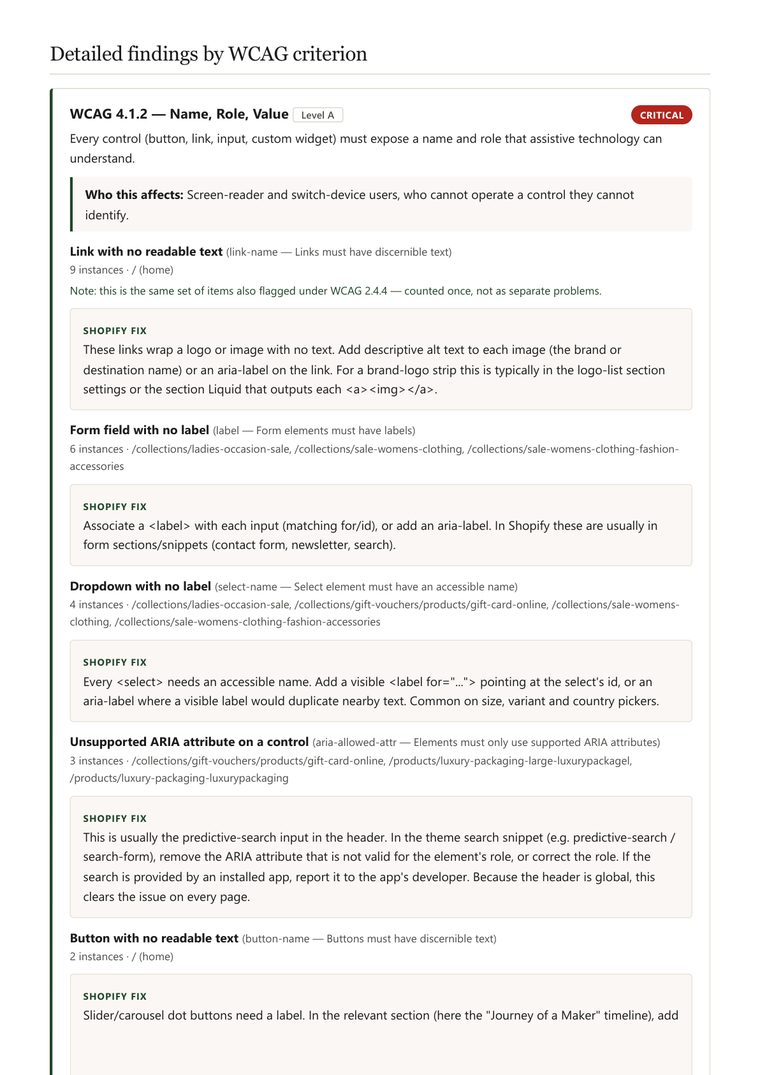
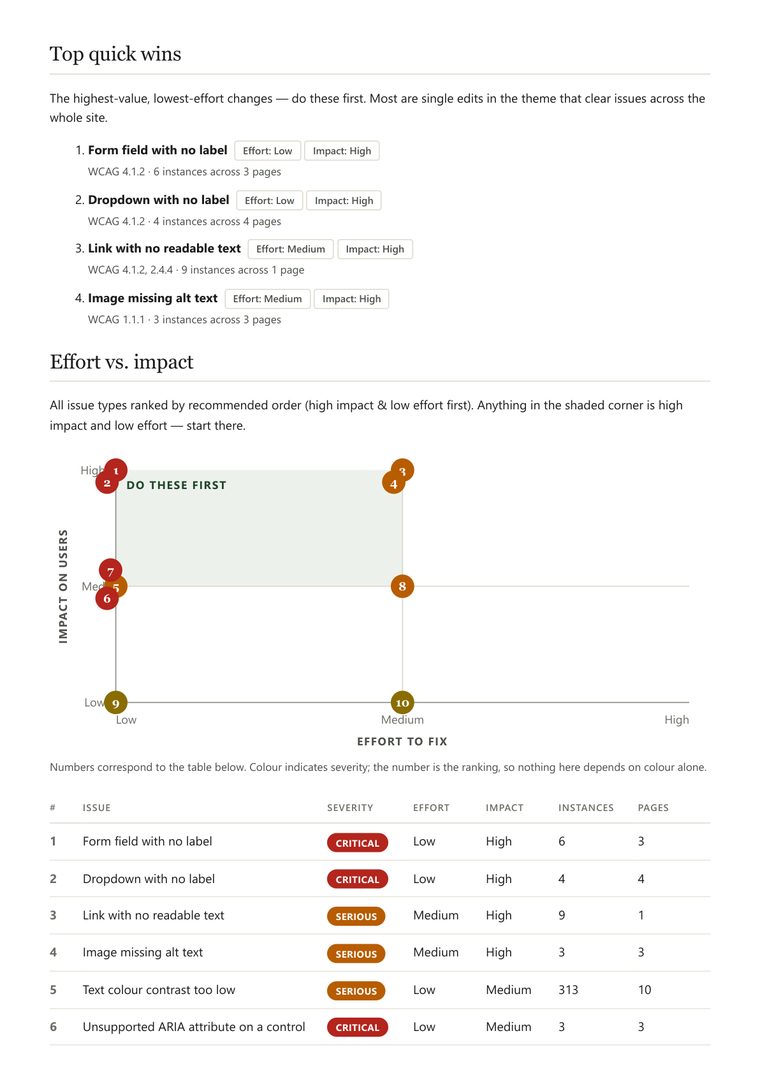
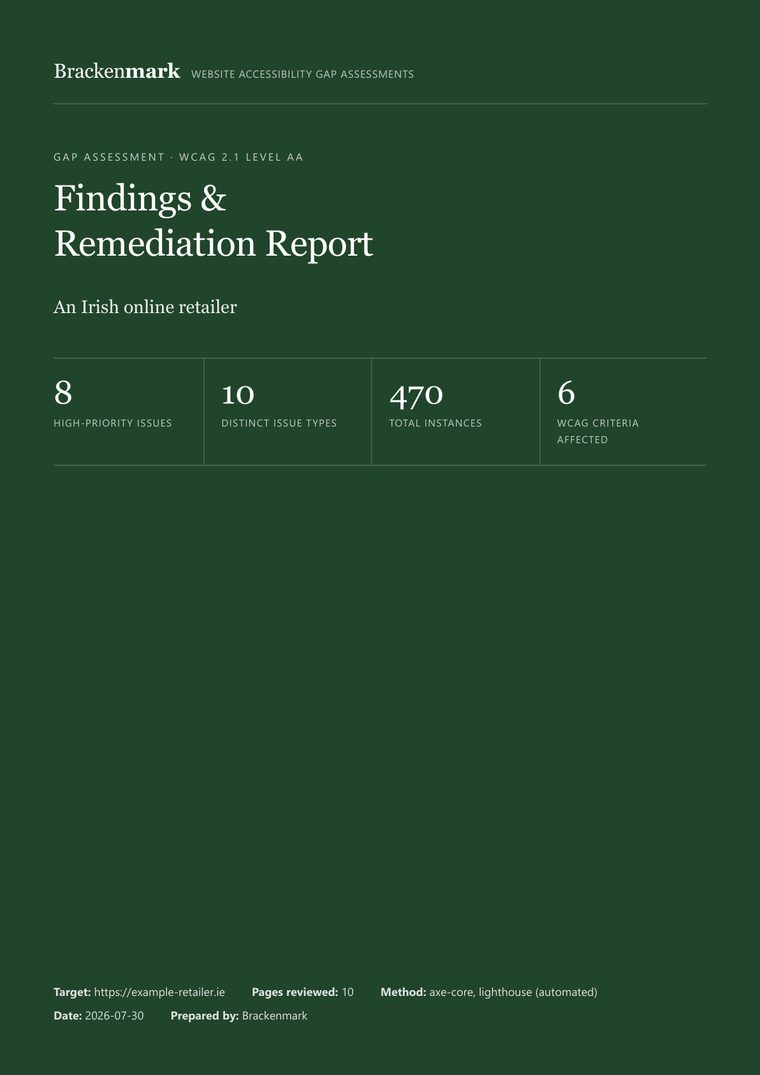
Three pages from the sample. All nine are yours to read.
The full assessment
What lands in your inbox
Every issue, ranked by severity
Automated detection against WCAG 2.1 Level AA across a representative set of your pages — home, category, product, and the content pages customers actually use. The detection is automated; nothing after it is.
Plain English, not standards-speak
What each issue is, who it shuts out, and why it matters — written so you can forward it straight to whoever maintains the site.
Fixes, not homework
Concrete remediation steps for every finding — not "improve contrast" with no indication of where or by how much. Where we can identify your platform, the steps name the actual setting or file to change; where we can't, they're written for whoever maintains the site, on any stack.
A dated PDF you can file
Evidence of when you assessed the site and what you found — useful if anyone ever asks what steps you took, and when.
Method
Exactly how the assessment is run
| Standard | WCAG 2.1 Level AA — the standard the European Accessibility Act references, and the benchmark used under the UK Equality Act. |
|---|---|
| Tooling | axe-core and Lighthouse, run against a real browser rendering your live site — not a source-code guess. |
| Reproducibility | Every finding is traceable to a named automated test, so the same site produces the same findings every time. Nothing is generated, inferred or guessed, and no AI detects or writes findings. Run it again next month and you can prove what changed. |
| Pages covered | A representative set: your home page, a category page, a product page, and the content and account pages customers pass through. Around ten pages on a typical shop. |
| Checkout | Not scanned. We don't send automated traffic through a live payment flow, and on most platforms checkout sits on a separate domain you don't control. If yours does, we flag it and say so. |
| What you get | Every detected issue, ranked by severity, each with a plain-English explanation and a specific fix. Platform-specific instructions where we can identify your platform — Shopify, WordPress, WooCommerce and others — and clear, concrete steps for any other stack. |
| Before it's sent | Every report is read end to end before it leaves — the right business name, figures that agree with each other, nothing carried over from another assessment. To be clear about what that is: a check on the document, not a second test of the site by hand. |
| Turnaround | Three working days from payment, usually faster. The free one-page check comes back within one working day. |
| If we can't reach your site | Roughly one site in eight blocks automated scanners at the firewall. If yours does, we'll tell you before taking any money, and send you the exact request to pass to your host — it usually takes them minutes. |
| What it can't do | Automated testing reliably catches roughly 30–50% of WCAG issues. Meaningful alt text, logical focus order and screen-reader experience need a human. We tell you which findings fall into that gap rather than pretending they don't exist. |
Scope
What this is, and what it isn't
This is a gap assessment, not a compliance audit. It identifies gaps between your website and WCAG 2.1 AA using automated testing.
Automated tools reliably catch a substantial share of accessibility barriers. They do not catch all of them. Some criteria can only be judged by a person, and some only by a person using assistive technology.
Completing this assessment — or fixing everything in it — does not make you legally compliant, and we will never tell you it does. It tells you where you stand and what to fix first.
Anyone offering you certified compliance from an automated scan, or a one-line script that "makes your site accessible", is selling you something they cannot deliver.
And if you employ fewer than 10 people with turnover under €2 million, you're a microenterprise — the European Accessibility Act's service requirements don't apply to you at all. We'd rather tell you that than sell you a deadline you don't have.
Plenty of exempt businesses buy this anyway, for reasons that have nothing to do with the Act. Barriers don't show up in your analytics: someone who can't finish a keyboard-only checkout doesn't complain, they leave, and it reads as an ordinary bounce. Around one in five people in Ireland and the UK lives with a long-lasting condition or difficulty, before you count anyone over sixty squinting at low-contrast text. If you tender for public sector work, accessibility is a mandatory technical specification in public procurement whatever your size. And if you sell in the UK, the Equality Act 2010 applies to service providers of every size — there is no small-business carve-out at all.
A commercial decision rather than a legal one — but not therefore a small one.
For agencies
Working through agencies
Assessment is the whole of what we do, so it sits alongside a build or a retainer rather than competing with one. We never name a business in anything we publish, including to the agency that built the site.
If that's useful, email contact@brackenmark.com.
Questions
Before you buy
What exactly do I get for €149?
One PDF report on your website, in the same format as the sample above. Every issue our tooling detects, ranked by severity, each explained in plain English with the fix spelled out. An accessibility statement drafted for your site, ready to publish. And a free re-scan after 90 days to confirm the fixes landed.
What's the free check, and what's the catch?
We run the same scan on your home page and email you what it finds. There's no catch and no charge. It's one page rather than ten, so it won't tell you what's wrong across your category, product and checkout pages — but what it does tell you is real, and it's yours whether you buy anything or not.
We'll email you the result and that's it. No mailing list, and one reply saying "no thanks" removes your details for good.
What is the 90-day re-scan?
Ninety days after your report, we run the same scan again on the same pages and send you a short note on what changed — what's been fixed, what hasn't, and anything new that's appeared since. It's included in the €149 and there's nothing to claim; we just do it.
It exists because a report you can't verify is only half useful. If you paid a developer to fix things, this is how you find out whether they did.
How long does it take?
Three working days from payment, usually faster. The free one-page check comes back within one working day. If anything about your site makes the scan awkward, we'll email you rather than go quiet.
Is this AI-generated?
No. The scanning is done by axe-core and Lighthouse — two established, open-source testing tools — run against your live site in a real browser. They check a fixed set of rules the same way every time, so the same site produces the same findings.
The plain-English explanations and the remediation steps come from a knowledge base written in advance, not generated per report. Nothing in your report is invented, summarised or guessed. If an issue is listed, a tool detected it on your site and can be pointed at the exact element.
We think that matters more than it sounds. An assessment you're going to hand to a developer needs to be reproducible, and a language model asked the same question twice won't always answer the same way.
Do you scan my checkout?
No, deliberately. We don't put automated traffic through a live payment flow, and on Shopify and similar platforms the checkout sits on a domain you can't edit anyway. If your checkout is on a separate domain, the report flags it so you know it's outside the assessment.
Does this make me compliant with the EAA?
No, and nobody honest will tell you otherwise. Automated testing catches roughly 30–50% of WCAG issues. This tells you where you stand and what to fix first. It is not a certificate, and we don't give legal advice.
Am I even covered by the European Accessibility Act?
If you employ fewer than 10 people and your turnover or balance sheet total is under €2 million, you're a microenterprise and the service requirements don't apply to you. Above that, and selling to consumers online, you're very likely in scope. We'd rather tell you that up front than sell you urgency you don't have. (UK businesses: the Act only reaches you on sales into the EU — but the UK's own Equality Act 2010 applies to service providers of every size, with no exemption.)
Exempt doesn't mean irrelevant, though. The Equal Status Acts have no size threshold, public procurement asks about accessibility regardless of how small you are, and customers who can't use your site leave without telling you. Different reasons, same report.
How does the €149 credit work?
Buy the assessment, and if you subscribe to Assured or Watch within 30 days, the full €149 comes off your subscription — off the first year on a yearly plan, or spread across your opening months on a monthly one. In effect, anyone who continues to monitoring gets the assessment free. There's nothing to claim; reply to your report email and we set it up.
What's the difference between Assured and Watch?
Watch tells you when something breaks: a monthly scan, an email only on change, a quarterly one-page record. Assured proves accessibility is being managed: fortnightly scans, a dated evidence pack every month even when nothing changed, your statement kept current with version history, notes when the rules change, and the full report re-issued quarterly. If you answer to a board, an insurer, a key account or a public-sector buyer, Assured is the one built for you. Neither is a certification, and both say so on every document.
Who's behind Brackenmark?
A small independent operation based in Ireland, working with shops and service businesses across Ireland and the UK. We don't put a founder photo on the page, because we'd rather you judged the work — which is why the complete report is published above rather than hidden behind a form. If you'd rather talk to a person first, email us and you'll get a reply from one.
What if the report is useless to me?
If it comes back with nothing worth fixing, we refund you in full. And you can read an entire report before spending anything, which is the best protection we can offer you.
No cookies · no trackers · no ads
Run the scan on this page first
The study includes results for an earlier version of our own site alongside all nineteen shops. The current site has since been redesigned; see our accessibility statement for its testing status. Test this page with an accessibility checker before you give us a euro.